 Rewards infrastructure for Africa
Corporate Reward Cards for African Employees: The 2026 Buyer's Guide
Everything HR teams need to know about corporate reward cards in Africa — types, occasions, budgets, and how to run a programme across 10 countries from one dashboard.
Abby Sotomiwa
Co-Founder & CEO, RibiRewards

Quick answer: Corporate reward cards let African companies send recognition to employees across multiple markets from a single dashboard — without bank transfers, currency headaches, or country-by-country vendor setups. RewardsCard by RibiRewards covers 10 African countries, delivers localised catalogues per market, and gives every recipient the choice of what to spend their balance on. This guide covers what to look for, how to budget, and which occasions work best.
Reward cards are now the default recognition tool for fast-growing African companies. They're flexible, they scale, and — when the catalogue is right — they feel personal to the employee receiving them. But the category has real variation. Choosing the wrong product creates just as much friction as the bank-transfer approach most companies are trying to move away from.
This guide covers everything HR and People teams need to know: the different types of reward card available in Africa, how to match card to occasion, what budget ranges make sense, and how to run a programme across multiple countries without the operational overhead.
Why reward cards work for African employee recognition
Before we get into the detail, it's worth being clear about why reward cards have become the dominant format for African HR teams moving beyond cash transfers.
- Choice. Unlike cash transfers that disappear into everyday expenses, a reward card gives employees a balance they spend on something they actually want — airtime, food delivery, wellness, dining. The The Psychology of Choice: Why Letting Employees Pick Their Reward Works is well-documented: recipients feel more valued when they decide how to use a reward than when they receive a fixed gift.
- Speed. Digital reward cards reach employees in seconds, regardless of which African city they're in. No courier delays, no physical distribution, no country-by-country logistics.
- Scale. A CSV upload and a funded wallet can send 500 reward cards across 8 countries in under five minutes. Manual gifting simply cannot match that.
- Data. Unlike bank transfers or cash envelopes, reward cards produce measurable outcomes: delivery confirmed, card opened, balance spent, categories chosen. That's the data The ROI of Employee Recognition: What Finance Actually Needs to See to justify the recognition budget.
- Localisation. A single reward platform that shows Nigerian employees MTN and Bolt Food while showing Kenyan employees Safaricom and Java House is doing something a generic voucher cannot: it's treating each employee as someone in a specific place with specific preferences.
Types of reward card available in Africa
Not all reward cards are the same. Understanding the options helps you pick the right one for your programme.
Single-retailer vouchers
Valid at one brand — MTN, Shoprite, Jumia, Safaricom. Simple and fast to procure, but with a major weakness: they only land well if that specific retailer is relevant to the recipient. A Shoprite voucher sent to a Nairobi employee fails entirely. Even in the right market, a single-retailer card tells the employee you didn't think particularly hard about what they'd want.
Multi-retailer vouchers
Broader than a single retailer, but the recipient is still constrained to a fixed set of brands. Better than a single-retailer voucher, worse than a genuine choice card. Platforms like SureGifts sit in this category. Fine for single-market Nigeria; inadequate for anything pan-African.
Choice-based reward cards
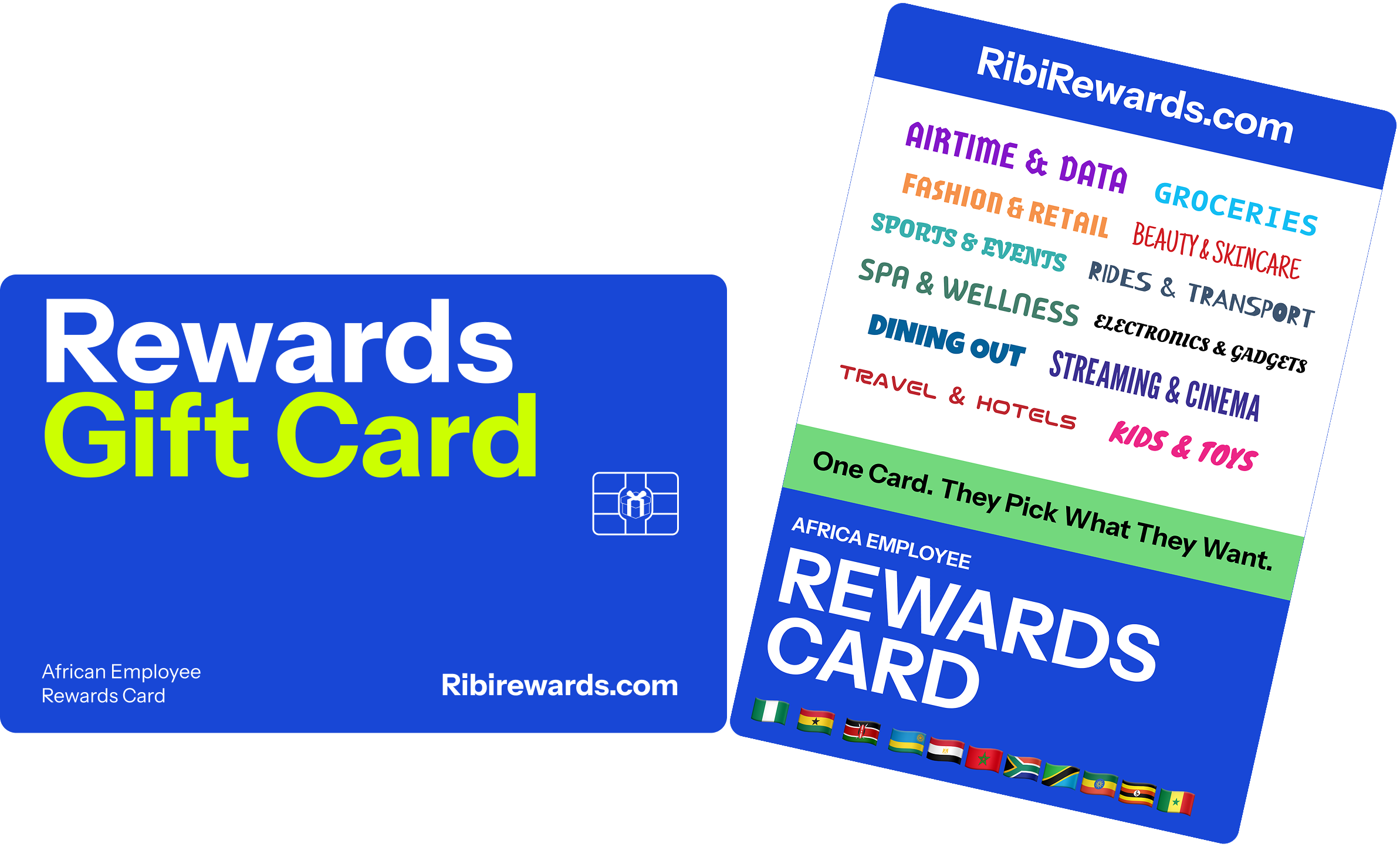
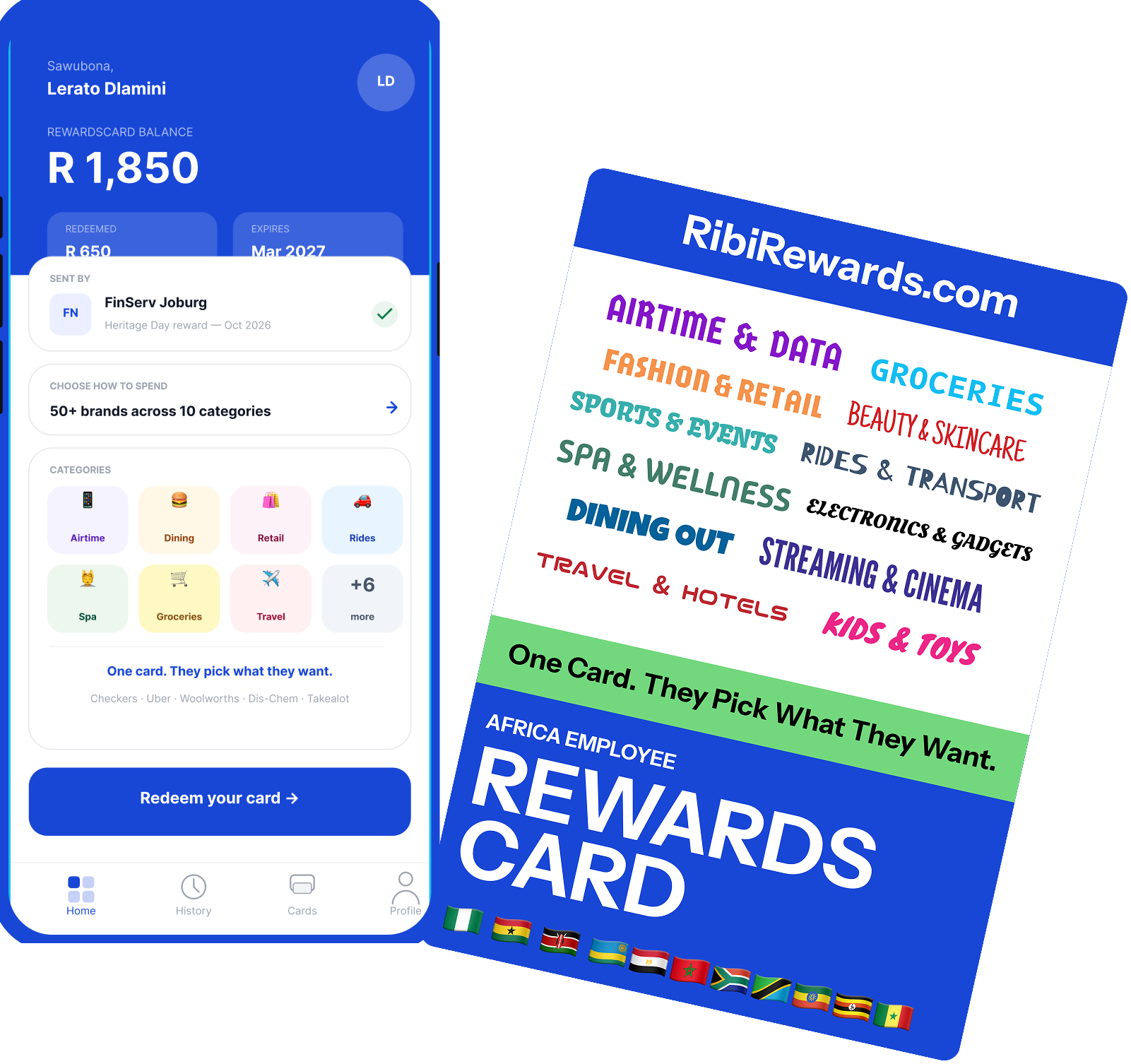
The recipient receives a balance and chooses what to spend it on from a localised catalogue. This is what RewardsCard delivers: every employee sees brands relevant to their country, plus a global layer (Netflix, Apple, Nike) that applies everywhere. The choice architecture is what drives Why 84% of RewardsCard Recipients Redeem Within 72 Hours— the highest utilisation rate in the category.
Physical cards
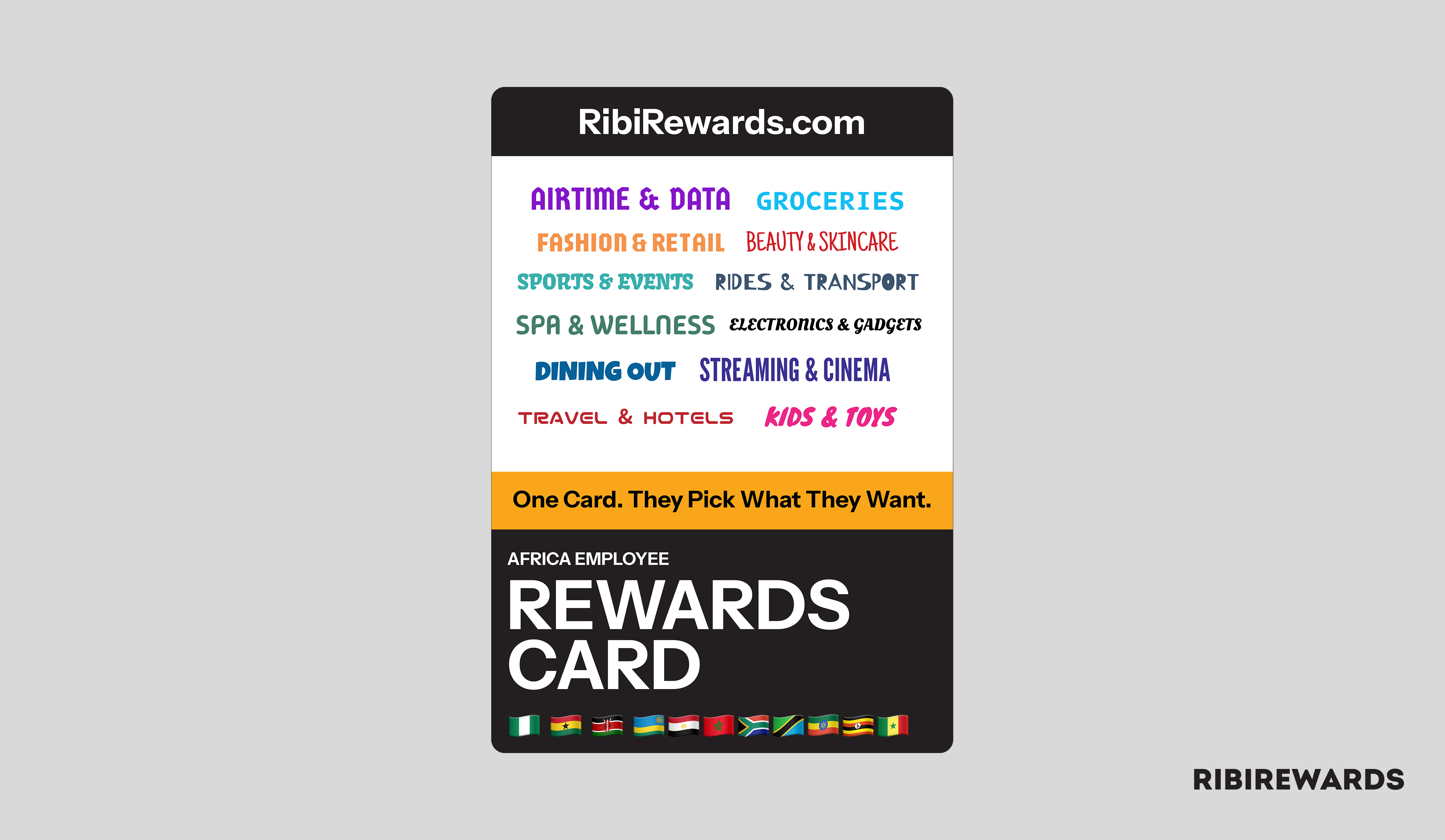
For milestone moments — work anniversaries, onboarding, end-of-year — a physical card in the hand creates a different kind of recognition moment. RewardsCard physical cards are fulfilled in-country across all 10 markets and carry the same choice architecture as the digital version. We've covered when to use each format in Digital vs Physical Reward Cards: Which Should You Send?.

Welcome

Excellence

Team

Season
Best reward cards by occasion
Not every moment calls for the same card or the same budget. Here's how to match the reward to the recognition moment.
Quick thank-yous and spot recognition (₦5,000–₦15,000 / KES 500–1,500)
A small airtime top-up, a food delivery credit, a coffee equivalent. The point is speed and frequency, not value. In Nigeria, MTN and Bolt Food credits at this level are the most redeemed in their respective tiers. In Kenya, Safaricom data and Glovo credits perform equivalently. This is also where Peer-to-Peer Recognition: Why Bottom-Up Beats Top-Down works well — low friction, high frequency.
Birthday and life-event gifts (₦25,000–₦50,000 / KES 2,500–5,000)
This is where flexibility matters most. You don't know everyone's preferences, so giving choice rather than guessing is always the stronger play. A choice card at this value lets the recipient pick dining, wellness, retail, or rides — whatever is relevant to them that day.
Performance rewards and project milestones (₦50,000–₦150,000 / KES 5,000–15,000)
Hitting targets, closing a deal, completing a major deliverable — these deserve something proportionate. The value should feel like an acknowledgement of effort, not a token gesture. A choice card at this tier gives the employee enough balance to do something genuinely memorable: a spa afternoon, a restaurant dinner, a premium subscription.
Work anniversaries and long service (₦150,000+ / KES 15,000+)
The moments that mark real tenure deserve real investment. A physical RewardsCard with an occasion-specific design, loaded with a meaningful balance, creates a completely different kind of recognition moment than an end-of-year bulk send. We've written specifically about Celebrating Work Anniversaries Without Breaking Your Budget and how to make the moment land at any headcount.
Budgeting: what African companies actually spend
Budget for recognition like it's a retention tool, not a discretionary expense. The correlation between recognition spend and perceived retention impact is direct and measurable: companies spending meaningfully on rewards are significantly more likely to report lower voluntary turnover than those treating it as an afterthought.
A working benchmark for African mid-market companies: allocate the equivalent of 1–3% of annual salary cost per employee for non-cash recognition. That funds birthday cards, spot recognition, work anniversaries, and end-of-year gifting without requiring a separate budget conversation for every occasion.
| Occasion | Nigeria (NGN) | Kenya (KES) | Format |
|---|---|---|---|
| Spot thank-you | ₦3,000–10,000 | KES 300–1,000 | Digital |
| Birthday | ₦20,000–50,000 | KES 2,000–5,000 | Digital or physical |
| Work anniversary (1yr) | ₦30,000–75,000 | KES 3,000–7,500 | Physical recommended |
| Performance milestone | ₦75,000–200,000 | KES 7,500–20,000 | Digital or physical |
| Work anniversary (5yr+) | ₦200,000+ | KES 20,000+ | Physical + ceremony |
| End of year | ₦50,000–150,000 | KES 5,000–15,000 | Digital bulk send |
How to run a multi-country reward card programme
The operational challenge for African companies isn't deciding to do recognition — it's doing it consistently across countries without creating a full-time logistics job. Here's the workflow that eliminates the friction.
- Fund a central wallet. Load once in your preferred currency. The platform handles local currency conversion per recipient automatically.
- Upload your recipient list as CSV. Name, email, country. That's it for digital sends. Add address for physical.
- Set values per tier. Same value for everyone, or tiered by seniority, tenure, or occasion.
- Hit send. Every recipient gets their card with their country's localised catalogue. Nigeria team sees Nigerian brands. Kenya team sees Kenyan brands. Simultaneously.
- Track via dashboard. Delivery, open, redemption — all visible per recipient. Export for finance.
Full walkthrough in How to Send Employee Reward Cards to 10 African Countries at Once.
What employees across Africa actually spend their cards on
Generic gift guides tell you what to send. Redemption data tells you what people actually choose when the choice is theirs. Across the RewardsCard platform:
- Nigeria: Airtime top-ups, food delivery (Bolt Food, Jumia Food), cinema, The Spa
- Kenya: Safaricom data, Java House, Glovo credits, Naivas groceries
- Ghana: MTN MoMo, Bolt Food, wellness, retail
- South Africa: Woolworths, Takealot, Uber Eats, Dis-Chem
- All markets: Netflix, Apple, Nike — the global catalogue performs consistently everywhere
Two things stand out. First: practical utility wins — employees use reward balances for things they'd buy anyway but treat as a little extra. Second: when given real choice, nobody picks the most generic option available. They pick what actually matters to them that week. That's the whole point.
For a deeper look at spending patterns, see Airtime, Food, Rides, or Spa? What African Employees Actually Spend Rewards On.
Build your reward card programme
Explore the full catalogue, country coverage, and HR workflow. View RewardsCard → or book a 20-minute demo.
FAQs
What is a corporate reward card for employees in Africa?
A corporate reward card gives employees a pre-loaded balance they can spend across a curated catalogue of brands. Unlike cash transfers, the card creates a deliberate recognition moment and leaves a data trail. Unlike fixed vouchers, it gives the recipient genuine choice. RewardsCard by RibiRewards operates this model across 10 African countries with fully localised catalogues per market.
Are reward cards better than cash bonuses for African employees?
For recognition purposes, yes. Cash bonuses are absorbed into everyday expenses within days and leave no lasting memory of the recognition moment. Reward cards create a distinct spending experience linked to the acknowledgement. The data consistently shows higher perceived value from choice-based reward cards than equivalent cash amounts — employees feel seen, not paid.
Can I send reward cards to employees across multiple African countries at once?
Yes. RibiRewards supports CSV bulk sends across all 10 live markets from a single dashboard. Fund a central wallet, upload your recipient list with country data, and send. Each recipient lands on a catalogue localised to their market. The whole process for a 200-person multi-country send takes under five minutes.
What brands are in the RewardsCard catalogue?
Each country has a localised catalogue: MTN, Airtel, Bolt Food, Jumia in Nigeria; Safaricom, Java House, Glovo in Kenya; Woolworths, Takealot in South Africa; and equivalents in all other markets. Every catalogue also includes global brands — Netflix, Apple, Nike, Zara — as a universal baseline.
Do reward cards work for both digital and physical delivery?
Yes. Digital RewardsCards are delivered by email link and reach recipients in seconds. Physical cards are available for milestone moments and are fulfilled in-country — not shipped internationally — across all 10 live markets.
Related reading
Abby Sotomiwa
Co-Founder & CEO, RibiRewards
Building rewards and recognition infrastructure for African and diaspora markets.
RibiRewards Insights
Practical analysis on incentive strategy, programme operations, reward delivery, markets and infrastructure across Africa.
One platform for every employee reward across Africa
Choice gift cards, benefits, recognition — managed from one dashboard in your currency and markets. Request a demo and we'll tailor it to your setup.
Gift Card API for Africa: Multi-Country Rewards Through One Integration
A practical guide to integrating local gift cards and reward delivery across African markets without building a supplier stack country by country.
Africa Rewards API: A Technical Guide for Global Reward Platforms
What global rewards, loyalty and incentive platforms need from an African rewards API: catalogue, funding, issuance, webhooks, reconciliation and local fulfilment.
How Global Incentive Platforms Can Add African Reward Coverage
A commercial and operational framework for extending an existing incentive or rewards platform into African markets through one infrastructure partner.