 Rewards infrastructure for Africa
What Is a Digital Reward Card? African Employee Rewards Explained [2026]
Digital reward cards deliver employee recognition instantly — no bank transfer, no courier, no delay. Here's how they work, why they replace cash transfers, and what to look for in Africa.
Abby Sotomiwa
Co-Founder & CEO, RibiRewards
![What Is a Digital Reward Card? African Employee Rewards Explained [2026]](/_next/image?url=https%3A%2F%2Ff005.backblazeb2.com%2Ffile%2Fribirewards%2Frewardscard-by-ribirewards-phone-card.png&w=3840&q=75)
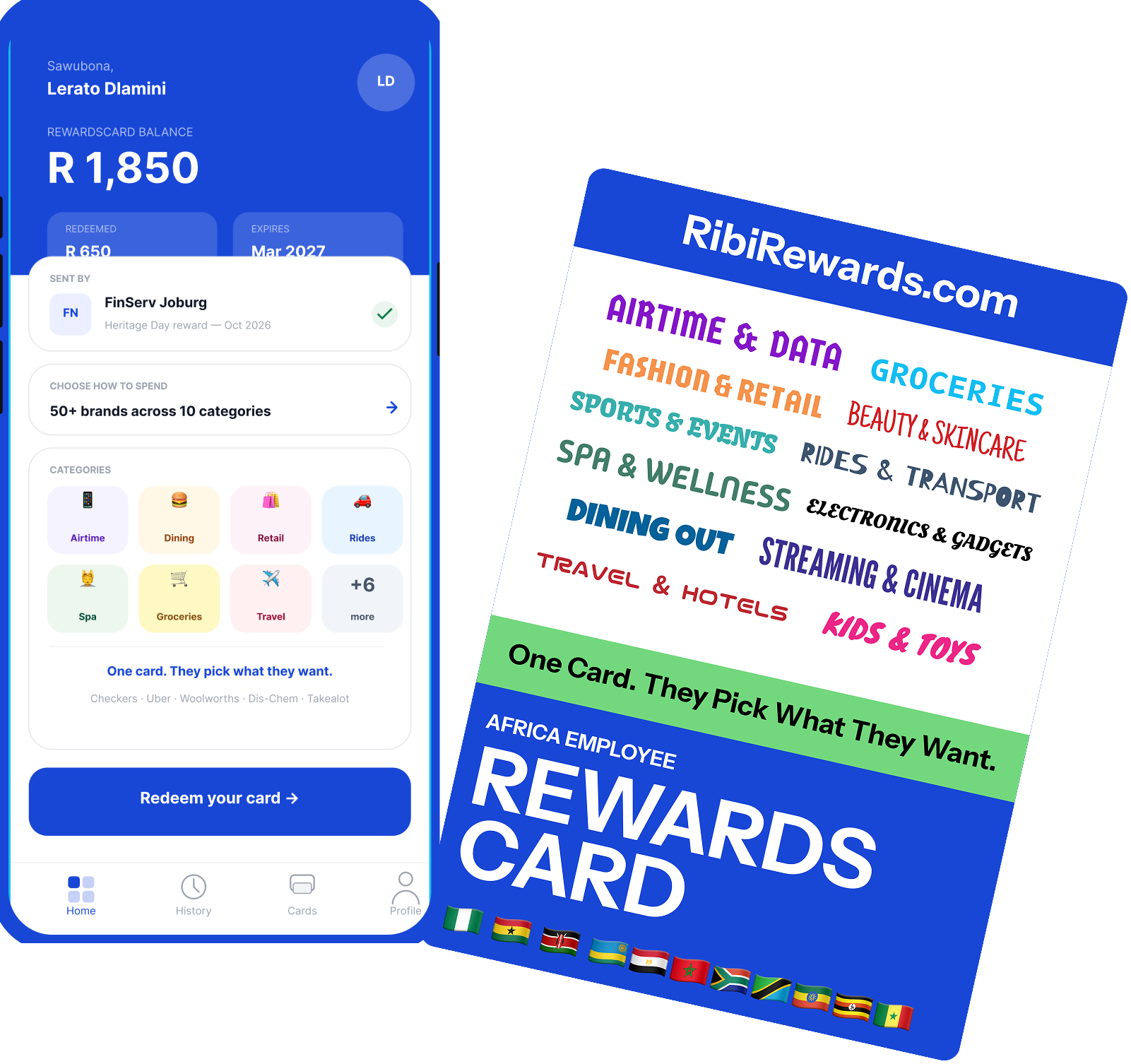
Quick answer: A digital reward card is an electronic reward delivered by email or SMS link — no plastic, no courier, no waiting. The recipient clicks through, sees their balance, and spends it on brands from a localised catalogue. For African HR teams, digital reward cards have replaced bank transfers as the default recognition format because they're instant, trackable, and — when built correctly — feel personal to each market.
Think about the last time your company sent a recognition reward as a bank transfer. It arrived alongside salary. It got absorbed into rent, transport, or groceries before the week was out. By Friday, the employee couldn't tell you it had happened. That's not a reward — that's payroll with a note attached.
Digital reward cards solve this by creating a distinct recognition moment that sits completely outside the payroll experience. This guide explains how they work, why they're replacing cash transfers across African companies, and what to look for when choosing a platform.
How digital reward cards work
The process is deliberately simple. An HR team loads a wallet, uploads a recipient list, and sends. Each employee receives an email or SMS with a personal note from the sender and a unique link. They click through, see a branded portal with their balance pre-loaded, and browse a catalogue of options. They pick what they want and redeem — usually in under two minutes.
No physical card. No courier. No address collection for digital redemptions. No app to download. The friction between "card sent" and "card used" is close to zero — which is exactly why digital reward cards see dramatically higher redemption rates than physical vouchers or bank transfers.
Digital reward cards vs cash transfers: the real difference
We've written a full breakdown of this in Why Bank Transfers Are the Worst Way to Reward Your African Team, but the core argument is this: cash rewards get absorbed. Reward cards get experienced.
| Bank transfer | Digital reward card | |
|---|---|---|
| Delivery time | Same day to 3 days | Instant |
| Recognition moment | Lost in payroll notifications | Distinct branded delivery moment |
| Recipient experience | Absorbed into expenses | Active choice — deliberate treat |
| Redemption tracking | None | Full per-recipient analytics |
| Localisation | None — same amount everywhere | Per-country catalogue |
| Cross-country sends | Complex FX, multiple accounts | Single dashboard, one wallet |
| Employee memory of it | Gone within a week | Remembered — often shared |
Types of digital reward cards
Single-brand digital vouchers
Redeemable at one specific retailer — MTN airtime, Safaricom data, Jumia credit. Fast to procure and simple to understand. The weakness: they only work if the recipient uses that brand. In multi-country teams, a significant portion of any single-brand send will be irrelevant to at least some recipients.
Multi-brand digital vouchers
Redeemable across a set of pre-selected brands. Better than single-brand, but the recipient is still constrained to whatever brands the issuer chose. If the set doesn't include anything relevant to their market or lifestyle, it fails in exactly the same way as a single-brand voucher.
Choice-based digital reward cards
The recipient receives a balance and chooses from a localised catalogue. This is what RewardsCard delivers. The employee in Lagos sees Nigerian brands; the employee in Nairobi sees Kenyan brands. Both also see a global layer (Netflix, Apple, Nike). Nobody receives a voucher for a retailer that doesn't operate in their city.
This is the format that drives Why 84% of RewardsCard Recipients Redeem Within 72 Hours. The choice architecture removes the "this isn't relevant to me" barrier entirely.
Why African companies are switching to digital reward cards
Several factors make digital reward cards particularly well-suited to African operating environments.
- Mobile-first populations. Employees across Nigeria, Kenya, Ghana, and South Africa primarily interact with digital services on their phones. A reward delivered as a mobile-optimised link meets them exactly where they already are.
- Distributed teams. Companies with employees across 5+ African markets cannot physically distribute gifts or vouchers at scale. Digital delivery removes the logistics problem entirely.
- Cross-border payment complexity. Bank transfers across African markets involve FX conversion, correspondent banking delays, and compliance overhead. A digital reward card sent from a single funded wallet sidesteps all of this.
- Reporting requirements. Finance teams increasingly need to account for recognition spend. Digital reward cards produce clean delivery and redemption data that cash transfers cannot provide.
Digital vs physical reward cards: which should you send?
Both have their place. Digital cards are the right default for high-frequency recognition — spot awards, birthdays, peer recognition, end-of-quarter sends. The instant delivery and high redemption rate make them efficient and impactful.
Physical cards earn their place for milestone moments — work anniversaries, onboarding packs, long-service awards — where the tangibility of the object itself adds to the recognition moment. A card on someone's desk, in an envelope, with a personal message signed by a team they respect, creates a different kind of memory than an email link.
We've covered the full decision framework in Digital vs Physical Reward Cards: Which Should You Send?.
"You earned it"
"Enjoy am"
"Sawa sawa"
"Go on then"
Send your first digital RewardsCard
Instant delivery across 10 African markets. Localised catalogues. 84% redemption in 72 hours. Explore RewardsCard → or book a demo.
FAQs
What is a digital reward card?
A digital reward card is an electronic reward delivered by email or SMS. It contains a link the recipient uses to access a pre-loaded balance and spend it on brands from a curated catalogue. There's no physical card, no postage, and no wait. For African teams, digital reward cards are the default format for fast, localised, scalable recognition.
How is a digital reward card different from a bank transfer?
A bank transfer merges with payroll and disappears into everyday expenses. A digital reward card creates a distinct recognition moment — the employee receives a branded delivery, opens a catalogue, and makes an active choice about how to treat themselves. That choice is what creates the recognition signal. The memory lasts; the bank transfer doesn't.
Can digital reward cards work across multiple African countries?
Yes, when the platform is built for it. RewardsCard supports simultaneous multi-country digital sends from a single HR dashboard. Each recipient lands on a catalogue localised to their country. Nigeria gets Nigerian brands. Kenya gets Kenyan brands. No manual country-by-country setup required.
Do digital reward cards expire?
Expiry policies vary by platform. RewardsCard balances are designed with recipient-friendly terms — employees can spend their balance over time and use partial amounts without pressure to commit everything at once. Check specific terms when setting up your programme.
What happens if an employee doesn't redeem their digital reward card?
Unredeemed cards are visible in the HR dashboard. You can see who opened but didn't redeem, and send automated reminders. This is a key operational advantage over bank transfers: with a digital reward card, you know whether recognition landed.
Related reading
Abby Sotomiwa
Co-Founder & CEO, RibiRewards
Building rewards and recognition infrastructure for African and diaspora markets.
RibiRewards Insights
Practical analysis on incentive strategy, programme operations, reward delivery, markets and infrastructure across Africa.
Put these insights to work for your team
RibiRewards turns employee recognition and rewards from a concept into a running programme. Book a call and we'll show you what it looks like in practice.
Gift Card API for Africa: Multi-Country Rewards Through One Integration
A practical guide to integrating local gift cards and reward delivery across African markets without building a supplier stack country by country.
Africa Rewards API: A Technical Guide for Global Reward Platforms
What global rewards, loyalty and incentive platforms need from an African rewards API: catalogue, funding, issuance, webhooks, reconciliation and local fulfilment.
How Global Incentive Platforms Can Add African Reward Coverage
A commercial and operational framework for extending an existing incentive or rewards platform into African markets through one infrastructure partner.